VIGO PHOTONICS · SMART TAIWAN
Infrared detectors and sensing modules
Choose infrared detectors and sensing modules by measurement task, operating wavelength, source, bandwidth, cooling and readout. SMART, an authorised VIGO Photonics distributor in Taiwan, coordinates mid- and long-wave infrared selection, manufacturer technical questions and quotations.
How to choose an infrared detector: start with the measurement
Infrared detection covers different tasks and sensing principles. PIR is common in motion detection; spectroscopy needs a specified source, absorption band and readout. This section focuses on VIGO photon detectors and modules.
Gas analysis and spectroscopy
Define the wavelength, optical path and laser or broadband source for NDIR, TDLAS or FTIR.
Infrared detector selection for gas analysis →Infrared sensing module integration
Compare amplification, cooling, channel count and readout interfaces before selecting a model.
Compare infrared sensing modules →Industrial and non-contact measurements
Review spot size, field of view, background, timing and calibration for single- or multi-point sensing.
Industrial infrared sensing selection →Component and module selection is covered here. Complete security equipment, thermal cameras or gas analysers require separate scope confirmation. Manufacturer reference: VIGO photon detector overview.
Full selection guide: wavelength, cooling, bandwidth and readout →
VIGO · SIGNAL PATH
From infrared light to an electrical signal
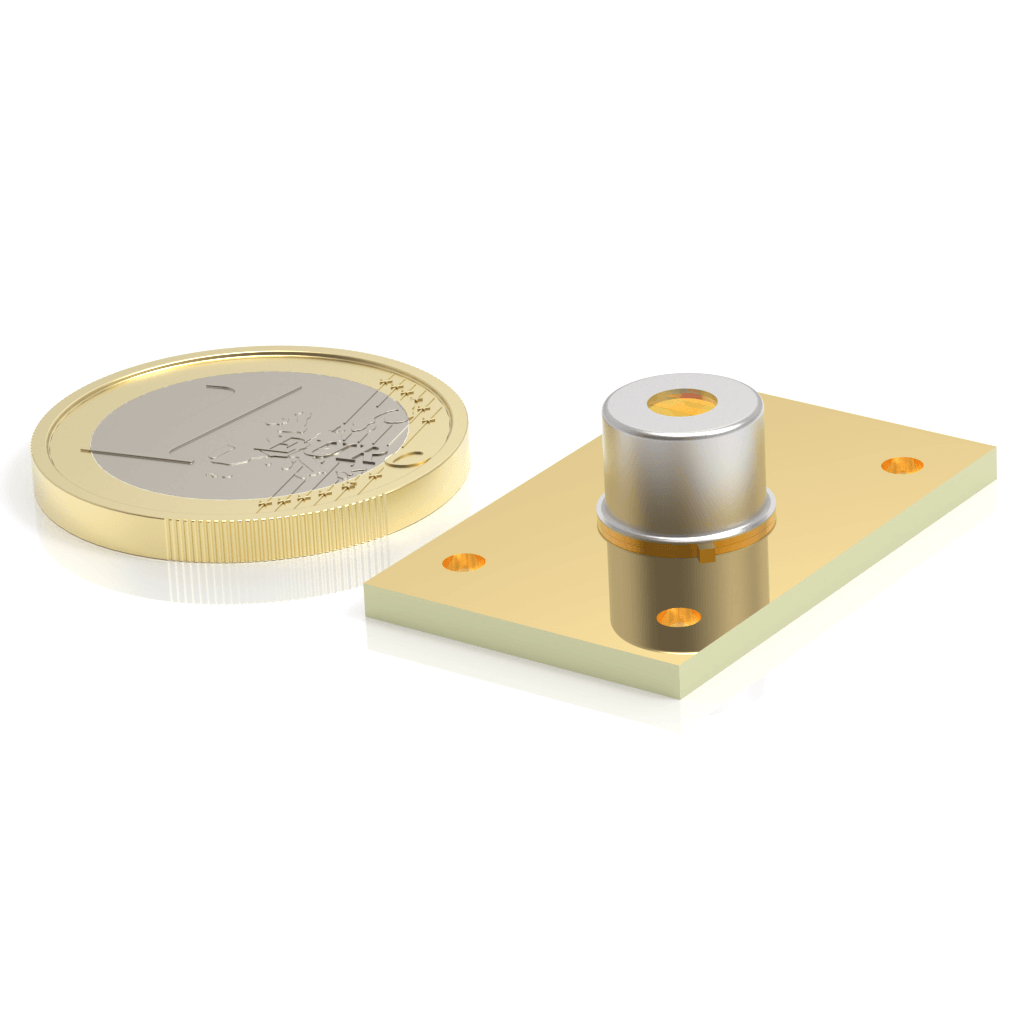
An AMS3140-01 example showing the roles of optical input, processing inside the module and external readout.
- 01 · OPTICAL INPUT
Incident infrared light
An optical path couples infrared light in the target band to the detector.
Optical coupling is application-dependent - 02 · VIGO MODULE
Detection & amplification
The AMS3140-01 converts incident infrared light into an electrical signal and amplifies it inside the module.
Integrated temperature control; differential analog output - 03 · EXTERNAL SYSTEM
Readout & acquisition
External measurement equipment or a suitable ADC reads the signal. Interface and sampling requirements depend on the system.
External readout is not included in this module
Conceptual signal path, not a wiring diagram. Confirm power, thermal design and readout interfaces against the manufacturer’s documentation.
Full signal path shown.
AM / AMS single-channel module selection
Compare four configurations, from an uncooled PCB to temperature-controlled modules, by wavelength, readout and thermal requirements.
Choose a product path
Infrared detectors
Select by wavelength, beam size, bandwidth and cooling; confirm amplifier and TEC requirements.
Multi-channel detection modules
Compare detector material, channel geometry, AC / DC readout and TEC integration.
III-V epi-wafers
Define device, substrate, layer-stack and acceptance requirements for a custom structure.
Start with the measurement task
Infrared detectors for gas analysis and spectroscopy
Begin with the absorption band, source and signal chain. Tunable-laser methods, FTIR and broadband measurements require different selection criteria. SMART helps define detector, amplifier and temperature-control requirements for manufacturer review.
Industrial infrared monitoring and multi-point sensing
Define the spectral band, field of view, response speed and environment for process monitoring, non-contact temperature measurements or multi-point optical sensing. Evaluate the complete measurement chain rather than a single sensitivity figure.
Infrared sensing evaluation for UAV and mobile platforms
For engineering teams evaluating infrared components, modules and readout configurations on mobile platforms. Define the sensing target, working distance, optics and platform resources before selecting a detector direction.
Infrared components for security and monitoring
For development work involving background radiation, fast optical signals and multi-channel readout. Define measurable optical and environmental requirements before evaluating MWIR detectors and integration components.
Local selection and manufacturer coordination
- Define application requirements, candidate models and full ordering codes.
- Review optics, amplifier, TEC, heatsink, readout and manufacturer drawings.
- Coordinate technical questions, evaluation options, quotation and lead time with VIGO.
Component and module selection is the starting point; complete-system development, validation and delivery scope are agreed per project.